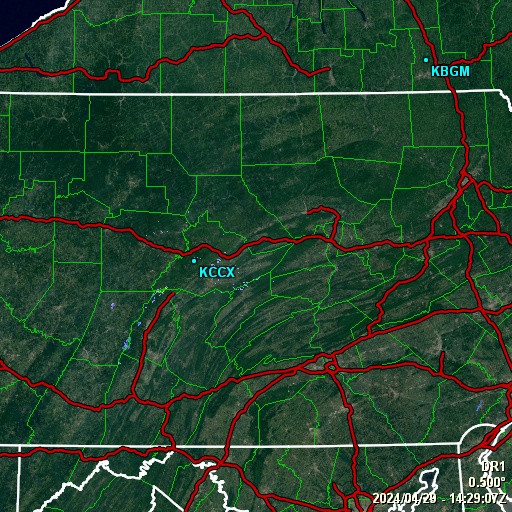
LIVE RADAR
| << |
Pause
1 2 3 4 5 6 7 8 9 10
|
>> |
This doppler radar loop is provided directly by the Sunbury Municipal Authority. The radar loop update time vary based on weather related events. During inactive times the radar is only updated every 15 minutes and under severe weather conditions, the radar can be updated up to the minute. To pause and play the animation, click on the word "Pause" to pause the animation or "Play" to play the animation. Once paused, you can navigate through the animation manually. To move foreward through the animation simply click on the "<<" located to the right of "Play" or "Pause". To step back click on the ">>" located to the left of the "Play" of "Pause". There are also numbers under "Play" or "Pause". These numbers represent the stops in the animation. When paused, you can click on these numbers to jump to varrious points in the animation.
What do the colors mean in the reflectivity scale?
 |
The colors represent different echo intensities (reflectivity) measured in dBZ (decibels of Z) durring
each elevation scan. "Reflectivity" is the amount of transmitted power returned to the radar reciever.
Reflectivity (designated by the letter Z) covers a wide range of signals (from very weak to very
strong) So, a more convenient number for calculations and comparison, a decibel (or logarithmic)
scale (dBZ), is used.
The dBZ values increase as the strength of the signal returned to the raday increases. The scale
(left) represents dBZ values when radar is in precipitation mode (dBZ values from 5 to 75).
The scale of dBZ values is also related to the intensity of rainfall (right). Typically, light rain is
occurring when the dBZ value reaches 20. The higher the dBZ, the stronger the rainrate. Depending
on the type of weather occurring and the area of the U.S., forecasters use a set of rainrates which
are associated to the dBZ values.
These values are estamates of the rainfall per hour, updated each volume scan, with rainfall
accumulated over time. Hail is a good reflector of energy and will return very high dBZ values. Since
hail can cause the rainfall estimates to be higher than what is actually occurring, steps are taken to
prevent these high dBZ values from being converted to rainfall.
|
 |
|